| Lesson 2 | Java operators |
| Objective | Summarize Java’s operators with clear rules, runnable examples, and common pitfalls. |
Java Operators: A Practical Summary
This page consolidates arithmetic, bitwise/shift, logical, comparison, assignment, ternary, and cast operators into a single, cohesive reference. Examples compile on modern Java (LTS or feature releases) and highlight gotchas such as short-circuiting, integer division, numeric promotion, and reference equality vs. value equality.
Arithmetic operators
Unary: + (no-op sign), - (negation), ++, --. Binary: +, -, *, /, %. With integers, division truncates toward zero; remainder (%) keeps the dividend’s sign. The + operator also concatenates String values.
| Operator | Description | Example | Result |
| + (unary) | Sign identification | +1 | 1 |
| - (unary) | Negation | -x | Flips sign of x |
| + (binary) | Addition | 2 + 2 | 4 |
| - (binary) | Subtraction | 3 - 2 | 1 |
| * | Multiplication | 4 * 4 | 16 |
| / | Division (truncates toward 0 for integers) | 19 / 4 | 4 |
| % | Remainder | 19 % 4 | 3 |
| + (String) | Concatenation | "abc" + "def" | "abcdef" |
Prefix vs. postfix
++x increments then yields the new value; x++ yields current value then increments. Same idea for --.
Bitwise and shift operators
Operate on integer types only: ~ (bitwise NOT), & (AND), | (OR), ^ (XOR), shifts <<, >> (arithmetic right, sign-extending), and >>> (logical right, zero-extending).
| Op | Description | Example | Result | Computation |
| ~ | Bitwise complement | ~3 | -4 | ~00000011 = 11111100 (two’s complement) |
| & | AND | 3 & 5 | 1 | 00000011 & 00000101 = 00000001 |
| | | OR | 3 | 4 | 7 | 00000011 | 00000100 = 00000111 |
| ^ | XOR | 5 ^ 4 | 1 | 00000101 ^ 00000100 = 00000001 |
| << | Left shift | 3 << 3 | 24 | 00000011 << 3 = 00011000 |
| >> | Right shift (sign-extending) | -6 >> 2 | -2 | keeps sign bits |
| >>> | Right shift (zero-extending) | 6 >>> 2 | 1 | fills with zeros |
Bitwise demo
public class BitwiseDemo {
  public static void main(String[] args) {
    System.out.println(~3);        // -4
    System.out.println(3 & 5);     // 1
    System.out.println(3 | 4);     // 7
    System.out.println(5 ^ 4);     // 1
    System.out.println(3 << 3);   // 24
    System.out.println(-6 >> 2);   // -2
    System.out.println(6 >>> 2);   // 1
  }
}
Boolean logical operators
These operate only on boolean: non-short-circuit &, |, ^, logical NOT !, and short-circuit &&, ||. Prefer short-circuiting in conditionals to avoid needless evaluation (and side effects).
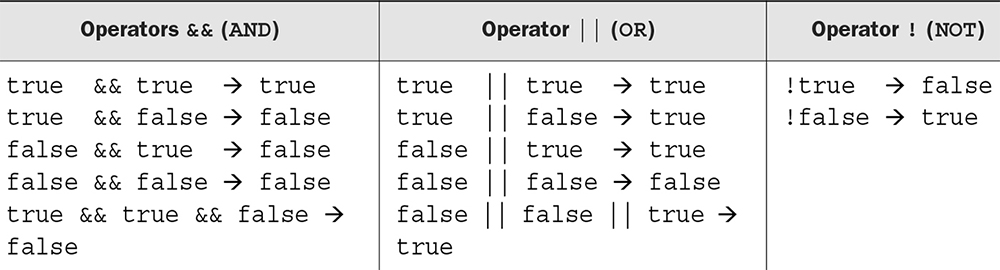
&&), OR (||), and NOT (!) using boolean literals.int a = 10, b = 20;
System.out.println(a > 20 && b > 10); // false (first term false)
System.out.println(a > 20 || b > 10); // true (second term true)
System.out.println(!(b > 10)); // false
System.out.println(!(a > 20)); // trueComparison and type-test operators
Relational: <, <=, >, >=. Equality: ==, !=. Type test: instanceof.
- Primitives:
==/!=compare values. - References:
==/!=compare object identity. Useequals()for value equality (e.g.,String). - Pattern matching (newer Java):
if (obj instanceof String s) { ... }safely narrows the type.
| Operator | Description | Example | Result |
| < | Less than | 1 < 2 | true |
| <= | Less than or equal | 1 <= 1 | true |
| > | Greater than | 1 > 2 | false |
| >= | Greater than or equal | 1 >= 1 | true |
| == | Equal to | 1 == 2 | false |
| != | Not equal to | 1 != 2 | true |
| instanceof | Type test / pattern match | "xyz" instanceof String | true |
Assignment and compound assignment
Simple assignment = plus compound forms: +=, -=, *=, /=, %=, &=, |=, ^=, <<=, >>=, >>>=.
- Numeric promotion:
short s = 1; s += 1;compiles (with implicit cast).s = s + 1;requires an explicit cast. - Assignment is an expression; avoid writing conditions that rely on it (readability suffers).
Ternary (conditional) operator
Form: condition ? whenTrue : whenFalse. Result types must be compatible or one convertible to the other.
int x = 7;
String parity = (x % 2 == 0) ? "even" : "odd";
Cast operator and conversions
(type) performs explicit conversion. Widening (e.g., int → long) is safe; narrowing (e.g., int → short) may overflow/truncate.
long big = 3_000_000_000L;
int narrowed = (int) big; // overflow: value wraps per two’s complement
Precedence & associativity (abridged)
From high → low: (), unary (+ - ! ~ ++ --), multiplicative (* / %), additive (+ -), shifts, relational (< <= > >= instanceof), equality (== !=), bitwise AND &, XOR ^, OR |, logical AND &&, logical OR ||, ternary ? :, assignment.
Use parentheses to document intent and avoid precedence mistakes.
Quick check (reads as true/false)
System.out.println( (3 / 2) * 2 == 3 );       // false (integer truncation)
System.out.println( "a" + 1 + 2 );            // "a12" (left-to-right, String first)
System.out.println( 1 + 2 + "a" );            // "3a" (numbers first, then String)
System.out.println( (null instanceof Object) ); // false
System.out.println( true & f());              // f() called (non-short-circuit)
System.out.println( true && f());             // f() called; left is true, must check right

static boolean f() { System.out.println("side-effect"); return true; }
Common pitfalls
==vsequals(): useequals()for value equality of objects (e.g.,String).- Short-circuiting: prefer
&&/||over&/|in boolean logic to avoid unintended side effects. - Integer math: remember truncation; use
double/BigDecimalwhen appropriate. - Shifts on negatives:
>>sign-extends,>>>zero-extends. - Compound assignment: implicit casts can hide narrowing—be explicit when clarity matters.