Java Programming Language
This course introduces the Java programming language in the context of the modern Java SE 25 platform. Java is a general-purpose, strongly typed, object-oriented programming language that runs on the Java Virtual Machine, usually called the JVM. It is used to build command-line programs, server-side applications, enterprise systems, cloud services, Android applications, desktop utilities, development tools, and data-processing software.
The purpose of this first lesson is to orient you to the course. You will learn what Java is, why it remains important, how Java programs are structured, and which programming concepts will appear throughout the course. The lesson also modernizes older Java training assumptions. Earlier Java courses often discussed applets, the Java 2 Software Development Kit, and browser-based Java programs. Those topics now belong mostly to Java history. A modern Java course should focus on applications that run on the JVM, use a modern JDK, and follow current programming practices.
Java SE 25 gives beginners a better starting point than older versions of Java. Traditional class-based Java remains essential, but Java now includes features that make simple programs easier to write and larger programs easier to maintain. This course therefore introduces Java as both a classic object-oriented language and a modern platform that has continued to evolve.
What Java Is
Java is a programming language and a runtime platform. The language gives you syntax for writing classes, objects, methods, variables, loops, decisions, exceptions, records, interfaces, and other program structures. The platform supplies the compiler, standard libraries, runtime environment, and JVM that allow Java programs to execute.
A Java source file is usually saved with a .java extension. The Java compiler compiles source code into bytecode. Bytecode is not the native machine language of Windows, Linux, or macOS. Instead, bytecode is executed by the JVM. This design is one reason Java became associated with portability. A Java program can often be compiled once and then run on different systems that provide a compatible JVM.
In practice, portability still depends on libraries, file paths, operating system integration, deployment configuration, and external services. However, the basic Java model remains powerful: write Java source code, compile it into bytecode, and run that bytecode on a JVM.
Java SE 25 Course Context
This course should be understood in the context of Java SE 25. Java SE 25 preserves the traditional Java model while adding features that make the language more expressive and beginner-friendly. Students should still learn classes, methods, constructors, packages, access modifiers, object references, and inheritance. Those concepts remain central to Java programming.
At the same time, modern Java includes features that reduce boilerplate and make programs easier to read. Records provide a concise way to represent simple data carriers. Enhanced switch expressions and pattern matching make certain decision structures clearer. Virtual threads help Java support high-throughput concurrent applications with a simpler programming model than older thread-per-task designs. Compact source files and instance main methods help beginners write first programs without immediately dealing with all of the ceremony required for large applications. Oracleâs Java documentation describes virtual threads as lightweight threads intended to reduce the effort of writing and maintaining high-throughput concurrent applications. :contentReference[oaicite:2]{index=2}
These modern features should not obscure Javaâs foundation. Java is still class-based, strongly typed, and object-oriented. The new features make Java more approachable, but they do not remove the need to understand the structure of real Java applications.
What You Will Learn in This Course
This course introduces the basic constructs used to write Java software. You will learn how a Java program is organized, how statements are executed, how variables store values, how data types control what kinds of values can be used, and how methods organize reusable logic.
You will also learn control flow. Control flow determines the order in which statements execute. Java provides conditional statements such as if and switch, loops such as for, while, and enhanced for, and exception-handling structures such as try, catch, and finally.
The course also introduces object-oriented programming. You will learn how classes define object structure, how objects represent runtime instances, how fields store object state, how methods define behavior, and how constructors initialize new objects. You will also study encapsulation, inheritance, polymorphism, and interfaces.
As the course progresses, you should develop the ability to read Java code, write small programs, debug errors, and understand how individual language features fit together. The goal is not only to memorize syntax, but to build a mental model of Java program execution.
Java Applications Instead of Applets
Older Java courses often presented applets as an important Java programming goal. Applets were small Java programs that could run inside a web browser. In the 1990s and early 2000s, applets were part of Javaâs public identity because they demonstrated the idea of running Java code through the web.
That model is now obsolete. Modern browsers do not support Java applets as a normal application model, and applets should not be presented as a current goal for students. In a modern Java course, students should focus on Java applications, backend services, command-line tools, object-oriented programs, data-processing utilities, and server-side development.
Java still has an important relationship to the web, but that relationship is no longer based on browser applets. Java is widely used on the server side, where applications process requests, connect to databases, expose APIs, generate dynamic content, and support enterprise systems. Java web development may involve servlets, JSP in legacy or traditional applications, Jakarta EE, Spring, REST services, and application servers or servlet containers.
Object-Oriented Programming in Java
Java is fundamentally object-oriented. A class is a blueprint that describes the data and behavior associated with a type of object. An object is a runtime instance of a class. Fields represent the state of an object, and methods represent the behavior that object can perform.
For example, a Customer class might contain fields such as customerId, firstName, and lastName. It might also contain methods that return the customerâs full name, validate customer information, or update customer state. A program can create many Customer objects from the same class, each with its own field values.
Object-oriented programming helps organize larger programs. Encapsulation keeps data and behavior together and protects implementation details. Inheritance allows one class to extend another class. Polymorphism allows code to work with a common type while different implementations provide different behavior. Interfaces define contracts that classes can implement.
Modern Java also includes records. A record is a concise way to declare a class whose main purpose is to carry data. Records do not replace ordinary classes, but they are useful when you want an immutable data carrier with less boilerplate code.
Java and the JVM
The JVM is one of Javaâs defining ideas. When you compile Java source code, the compiler produces bytecode. The JVM loads that bytecode, verifies it, manages memory, executes instructions, and provides runtime services such as garbage collection.
This execution model makes Java different from languages that compile directly to one specific machine architecture. A Java program can run on different systems if those systems provide a compatible JVM and the programâs dependencies are available. This design helped Java become important in enterprise environments where applications needed to run across different operating systems and server platforms.
The JVM also supports languages other than Java, but this course focuses on Java itself. Understanding the JVM will help you understand why Java uses bytecode, why class files matter, why the classpath or module path matters, and why memory management is handled differently from languages such as C or C++.
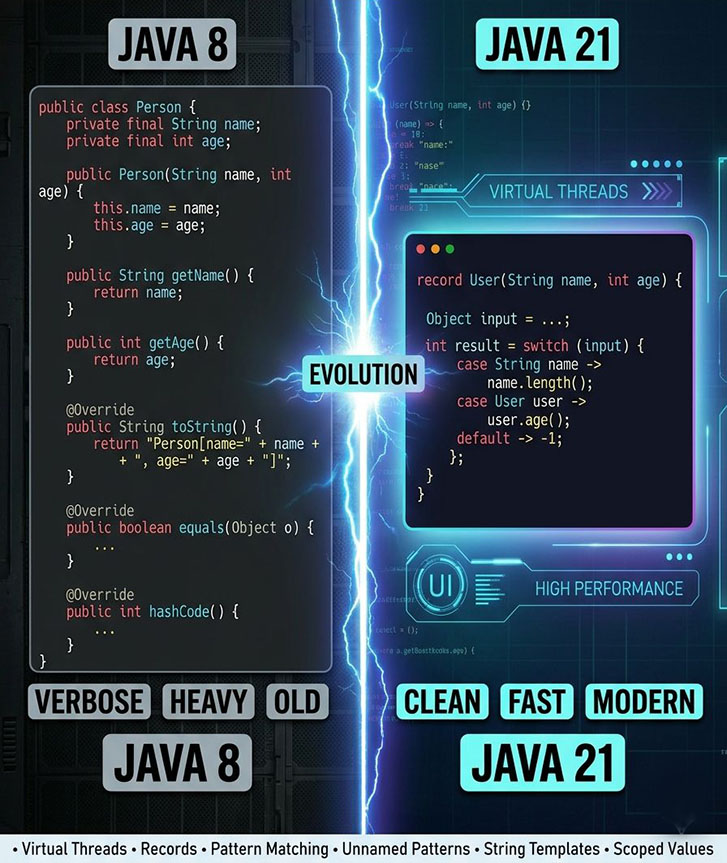
Java Then and Now
Responsive Square
The image on this page illustrates an important point: Java has changed, but it has not abandoned its foundation. Older Java programs often required more boilerplate code. A simple data object might require fields, constructors, getters, setters, equals(), hashCode(), and toString(). Modern Java records can express some of those data-carrying patterns more directly.
Similarly, older control-flow structures often required longer chains of if statements or verbose switch blocks. Modern switch expressions and pattern matching can make certain forms of decision logic more readable. Oracleâs Java SE 25 language documentation describes pattern matching with switch as allowing case labels to contain patterns, giving switch more flexibility and expressiveness than testing only exact constants. :contentReference[oaicite:3]{index=3}
The important lesson is continuity. A student who learns Java SE 25 is still learning Java. Modern Java is not a separate language. It is the current form of a language that has evolved over decades while preserving much of its original design.
Java History in Brief
Java was developed at Sun Microsystems in the early 1990s. James Gosling is one of the central figures associated with its creation. The language was originally connected to embedded and consumer-device ideas. It was designed to be portable, reliable, secure, and suitable for running on different types of hardware.
Java became widely known in the mid-1990s, especially because of its connection to the web and browser applets. Applets are now historical, but they played an important role in making Java visible to developers and technology companies. Java was introduced publicly in the 1990s and quickly became one of the most important programming languages in the software industry.
Over time, Java moved far beyond applets. It became a major platform for enterprise systems, web applications, server-side development, mobile development, cloud applications, build tools, testing frameworks, and educational programming. The Java ecosystem grew to include the JDK, the JVM, OpenJDK, Jakarta EE, numerous frameworks, and a large collection of libraries.
Oracle later acquired Sun Microsystems, and Java continued to evolve through the Java Community Process and the OpenJDK ecosystem. Current Java releases continue to improve the language, standard libraries, runtime performance, tooling, and developer experience.
Course Goals
After completing this course, students should be able to:
- Explain what Java is and why it remains useful.
- Install and use a modern Java Development Kit.
- Compile and run Java programs.
- Describe the role of the Java Virtual Machine.
- Write basic Java applications.
- Use variables, primitive types, reference types, expressions, and operators.
- Control program flow with conditionals and loops.
- Define classes, objects, fields, methods, and constructors.
- Apply basic object-oriented programming concepts.
- Use arrays and collections to organize data.
- Handle basic exceptions.
- Recognize records, enums, interfaces, and packages as important Java constructs.
- Understand how Java fits into modern web, enterprise, cloud, backend, and educational development.
- Distinguish historical Java applets from modern Java applications.
Summary
This lesson introduced the Java programming language as the foundation for the course. Java is a strongly typed, object-oriented language that runs on the JVM and supports a wide range of modern software development tasks. It can be used for small learning programs, backend services, enterprise systems, cloud applications, and development tools.
The course should be understood in the Java SE 25 era. That means students should learn traditional Java structure while also becoming aware of modern Java features such as records, enhanced switch expressions, pattern matching, virtual threads, compact source files, and instance main methods. These features make Java more concise and approachable, but they do not remove the need to understand classes, objects, methods, data types, control flow, and object-oriented design.
Older Java topics such as applets and the Java 2 SDK belong to historical context. A modern Java programming course should prepare students to write JVM-based applications using a current JDK and current Java terminology. With that foundation in place, the remaining lessons can introduce the core programming constructs needed to write clear, reliable, and maintainable Java code.